Thursday, November 18, 2021

Expanding Curricular Options: If You Lived During the Plimouth Thanksgiving

At the start of each school year, I always find myself saying to a student or a colleague: "How do we still not have a range of books about colonization in New England written from the Indigenous perspective?" In Massachusetts, where Erika and I both teach, First Contact, colonization, and the 1621 harvest celebration in Patuxet/Plimouth - an event which morphed in public consciousness with the Thanksgiving holiday in the mid-19th century - appears in social studies standards across grade levels. For too long, we've lacked adequate children's literature of all genres to fully explore these topics from multiple perspectives. Slowly, this is beginning to change. 

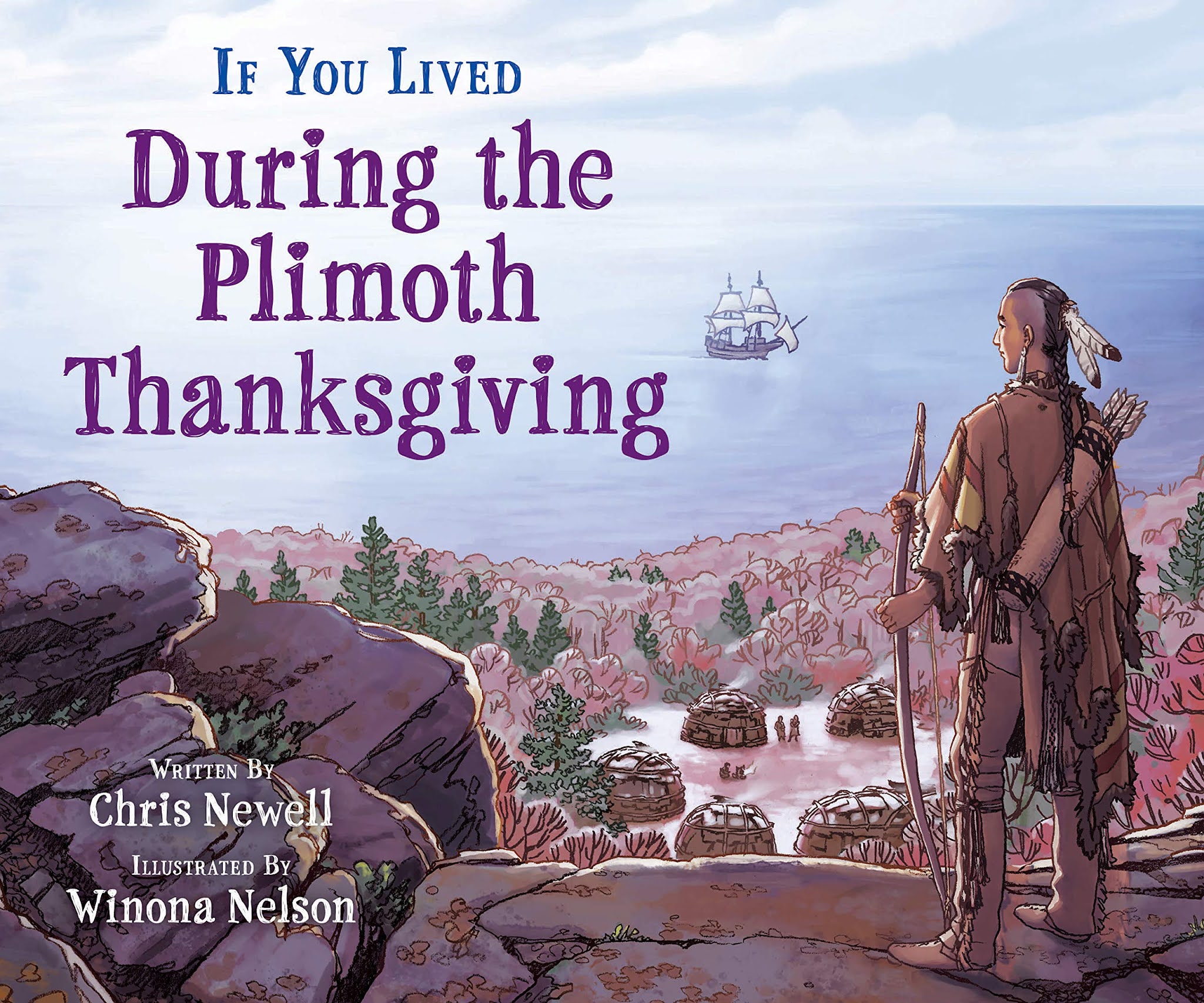
Earlier this month, rather quietly, one of those long-awaited books arrived. Scholastic published If You Lived During the Plimouth Thanksgiving, a new title in its long-standing "If You" series. Written by Chris Newell, a citizen of the Passamaquoddy Tribe from Motahkmikuhk (Indian Township, Maine) and illustrated by Winona Nelson, a member of the Leech Lake Band of Minnesota Chippewa, If You Lived During the Plimouth Thanksgiving is an effective re-examination of the events of 1620-1621. It's the first book that I know of since Margaret Bruchac, Abenaki, and Catherine Grace's 1621: A New Look at Thanksgiving (2001) that is written from an Indigenous perspective and offers background information about both the Wampanoag and the English. 

Newell gently reminds the reader that "[t]he story of the Mayflower landing is different depending on whether the storyteller viewed the events from the boat or from the shore."  This expository book covers a lot of content, from basic concepts (colonization, pilgrim), to background information on how earlier European fishermen and slave traders shaped Indigenous people's perceptions of the English, to basic information on the daily lives and beliefs of both the Wampanoag and the English. Throughout the book, Newell threads in that background context, reminding his readers of the larger forces and events that influenced and shaped the relationship between the Wampanoags and the English. In keeping with the series, a question and answer text structure is adopted; all headings are phrased as questions, inviting readers to engage with the text. 

Newell does not sugar coat this history; he invites readers to engage with it. In his introduction, he reminds readers that "Before the arrival of any Europeans, Native peoples lived in America by the millions. Entire nations of people connected by land, kinship, language, and culture existed on the continent for more than twelve thousand years." The book concludes with contemporary Indigenous views on Thanksgiving, leaving the reader with the knowledge that despite centuries of policies to remove Indigenous tribes and nations from their lands, they remain a vibrant part of our nation's culture.  

Gratefully, Winona Nelson's illustrations offer elementary readers a vision of what Patuxet/Plimouth looked like in 1620-1621 that steers clear of the inaccurate and often racist 19th and early 20th century paintings that manage to dominate so many nonfiction books on this topic. 

One concern - the title of the book includes, and therefore privileges, the "Plimouth Thanksgiving," an event that never happened. The inclusion of the phrase certainly grabs the attention of teachers, librarians, and other adults eager to share this history with the young people in their life. But I wonder if it might confuse elementary age readers? 

Scholastic has assured readers on the back cover that the manuscript was "[v]etted by experts," and a Linda Coombs, Aquinnah Wampanoag, is thanked on the verso page. I still wish there was a bibliography, but I'm not sure I've ever seen that kind of back matter in this series. 

You can read reviews from Kirkus Review and School Library Journal

As always, if you seek information on the representation of Indigenous peoples in children's literature, these are our go to resources: 

American Indians in Children's Literature Blog 

The American Indian Library Association and its American Indian Youth Literature Award 

Social Justice Books: American Indians/Indigenous Peoples/Native Nations Booklist 

Additional Information: 

Plimouth Patuxet Museum 

Wampanoag Mashpee Tribe

Wednesday, November 17, 2021

NCTE 2021!!


We're so looking forward to the start of NCTE 2021 in less than twenty four hours! Look for our pre-recorded session with fellow teacher educator Xenia Hadjioannou, author-illustrator Don Tate, and author Jen Bryant within the NCTE conference site. We're presenting on behalf of all of our colleagues at The Biography Clearinghouse!

OD-290 Using Life Stories for Justice, Equity, and Antiracist Teaching: The Biography Clearinghouse

Friday, May 3, 2019

"Movement and Migration: Teaching with Children's Literature" - Join Us at Lesley University One Week This Summer!


This summer, July 8th-12th, we will be offering a professional development institute at Lesley University called "Movement and Migration: Teaching with Children's Literature." In this five-day institute, we will explore children's, middle grade, and young adult literature of all genres that explore immigration and migration. 


Here is the description of our program: 

"Human beings are on the move. Climate change, political
unrest, and economic instability have unleashed unprecedented migrations globally. How do we respond to students who have experienced traumatic relocation? How do we help all of our students understand the people behind the news stories? What can we learn from the past that helps us to understand the present? 

During our week together, we'll explore a range of children’s, middle grade, and young adult books that convey contemporary and historic refugee and immigrant experiences. We’ll hear from authors as well as experts in immigration and the global refugee crisis. Ultimately, we’ll explore the potential for multimodal, multigenre text sets to anchor explorations of human movement and migration in language arts, social studies, and science in grades K–12. With an emphasis on curriculum development, the institute will focus on the use of young people’s literature as a vehicle to explore multiple perspectives, teaching strategies for various genres, and issues related to differentiated instruction and text complexity for diverse learners. 

For more information: Contact Rodney Durand at 617.349.8511 or at capse@lesley.edu. You can find out more at the Center for Advanced Professional Studies in Education (CAPSE) at Lesley University. 
 .

Wednesday, September 19, 2018

Text Sets in NYC!

Mary Ann had a great day on Friday, September 14th, working with the NYC Department of Library Services on the role of text sets in their Reading in Action Grant.


To take a look at our NYC Trash Text Set, follow this link.  

Monday, April 4, 2016

JFK Library Conference Wednesday, April 6th

Mary Ann is looking forward to working with Tonya Bolden, Candace Fleming, Emily Arnold McCully, Andrea David Pinkney, and Myra Zarnowski at the "New Frontiers in Biography and History" conference at the JFK Presidential Library this Wednesday, April 6th. This conference for teachers and librarians in sponsored by the John Fitzgerald Kenney National Historic Site and the John F. Kennedy Presidential Library and Museum.  For New England folks who wish to attend, you can go find out more here

Wednesday, December 2, 2015

NCTE 2015 - Orbis Pictus and Huck Awards

Erika wrote a story for School Library Journal, "Five Reasons Why the 2015 NCTE Conference was the Best Yet," covering the annual convention. Within her story, you'll read all about the events. It was particularly exciting for us as Mary Ann is serving her first year as a member of the Orbis Pictus Committee for Outstanding Nonfiction for Children (K-8). You can find out about the children's book award winners from the NCTE press release. 

Sunday, November 15, 2015

NSTA Outstanding Science Trade Books 2016

We took a break from this website, but we're back and ready to provide you with more regular updates and resources in your efforts to teach with text sets.

The latest list of outstanding science trade books has been posted by the National Science Teachers Association (NSTA). We're excited to see a lot of our favorite titles from 2015 included on this list.

For those of you who are not familiar with this list, some background knowledge: each year, the NSTA teams up with Children's Book Council (CBC) to identify the best science-based titles for a particular year. These are books with provide important science content, model great writing and scientific thinking, and are appropriate for classroom use.

For a full set of lists, going back to 1996, you can go to the Outstanding Trade Books section of the NSTA website.